

A full cart loaded with high-value products rolls past the checkouts and heads straight for the exit. Store employees see it happen. They may recognize the person and they may even know exactly what is in the cart.
And still, they do not step in. That can look frustrating from a distance. To customers, store managers or head office teams, it may seem as if store staff are doing nothing. But in reality, they are often doing exactly what they have been told to do.
For the store team, the problem is immediate: a cart is leaving with unpaid merchandise. For corporate teams, the problem is broader. The same incident can be repeated across dozens or hundreds of locations, creating a loss pattern that is difficult to see, measure and manage at scale.
Most retailers have a clear no-intervention policy for a reason. Confronting someone during a suspected theft incident can put employees at risk, especially when organized groups are involved. Protecting retail employee safety during theft incidents is the right priority. But while the policy is right, it leaves a difficult gap in store operations.
If store teams are not allowed to physically intervene, and existing systems only record what happened afterwards, then who or what is actually stopping the cart from leaving? And for retail organizations operating across multiple locations, there is a second question: how can head office create a consistent prevention strategy when every store is left to observe, report and react differently?
Push-out theft is not always subtle. In many cases, it happens in plain sight, during regular opening hours, with customers and employees nearby.
A person fills a cart with products, moves through the store, bypasses the checkouts and heads for the exit. Sometimes the team has seen the same behavior before. Sometimes they recognize the pattern immediately. They may know which products are in the cart, which route the person is taking and what is about to happen next.
The same challenge appears around self-checkout. Store teams may notice that items are not being scanned, that a cheaper product is being selected instead, or that a cart is moving through with far more goods than the receipt suggests. But noticing suspicious behavior is not the same as being able to stop it.
For many employees, this is the most frustrating part of push out theft store staff face every day: they see the situation unfold, but they are limited in what they can do. They can observe and they can report. They can review footage later but in the moment itself, the cart leaves the store with the unpaid merchandise.
A “no intervention policy” is not a sign of weakness. It is a sign that the company takes employee safety seriously. Confronting suspected shoplifters can be unpredictable. The risk becomes even higher when incidents involve organized groups, multiple people, distraction tactics or individuals who are prepared to escalate. What starts as an attempt to stop unpaid goods from leaving the store can quickly turn into a safety issue for employees, customers and bystanders.
That is why many retailers instruct their staff not to physically intervene. Employees are not security guards. Their role is to run the store, support customers, replenish shelves, manage checkouts and maintain daily operations. Asking them to personally stop a cart at the exit creates a responsibility that most store teams should not have to carry.
There is also a liability risk. If an employee or customer gets hurt during a confrontation, the consequences can be far greater than the value of the stolen goods. From a corporate perspective, a clear no-confrontation policy helps protect people and reduce legal exposure.
So the policy itself is not the problem, and it should not be changed. The question is: What can be done to maintain policy while still putting a stop to shoplifting? Because stopping shoplifting without confrontation requires more than telling employees to stand back. It requires a system or process that fills the gap left behind.
When store staff are told not to intervene but are still expected to deal with the consequences, it creates a difficult dynamic on the floor. Employees may feel powerless. They watch high-value merchandise leave the store, sometimes repeatedly, without being able to stop it. Over time, this can affect morale and the sense of control within the store.
It can also create frustration between stores and head office. Local teams may feel that the problem is visible and urgent, while the organization above them does not fully understand the daily impact. From their perspective, they are not dealing with isolated incidents. They are dealing with behavior that repeats, escalates and becomes part of the store’s operating reality.
Then comes the administrative burden. After an incident, employees or store managers often spend time reviewing camera footage, writing reports, logging details and trying to reconstruct what happened. But this is reactive work. It happens after the cart has left, after the merchandise is gone and after the opportunity to prevent the loss has passed. Even then, the evidence may not be clear enough. The store team may be left with assumptions, partial footage or anecdotal statements such as, “We think we saw it happen.” That is not a strong operational position. It takes time, creates frustration and rarely gives the team a practical way to prevent the next incident.
Discover how to calculate the true financial impact, build a defensible business case, and evaluate the effectiveness of checkout security solutions.
Download the whitepaper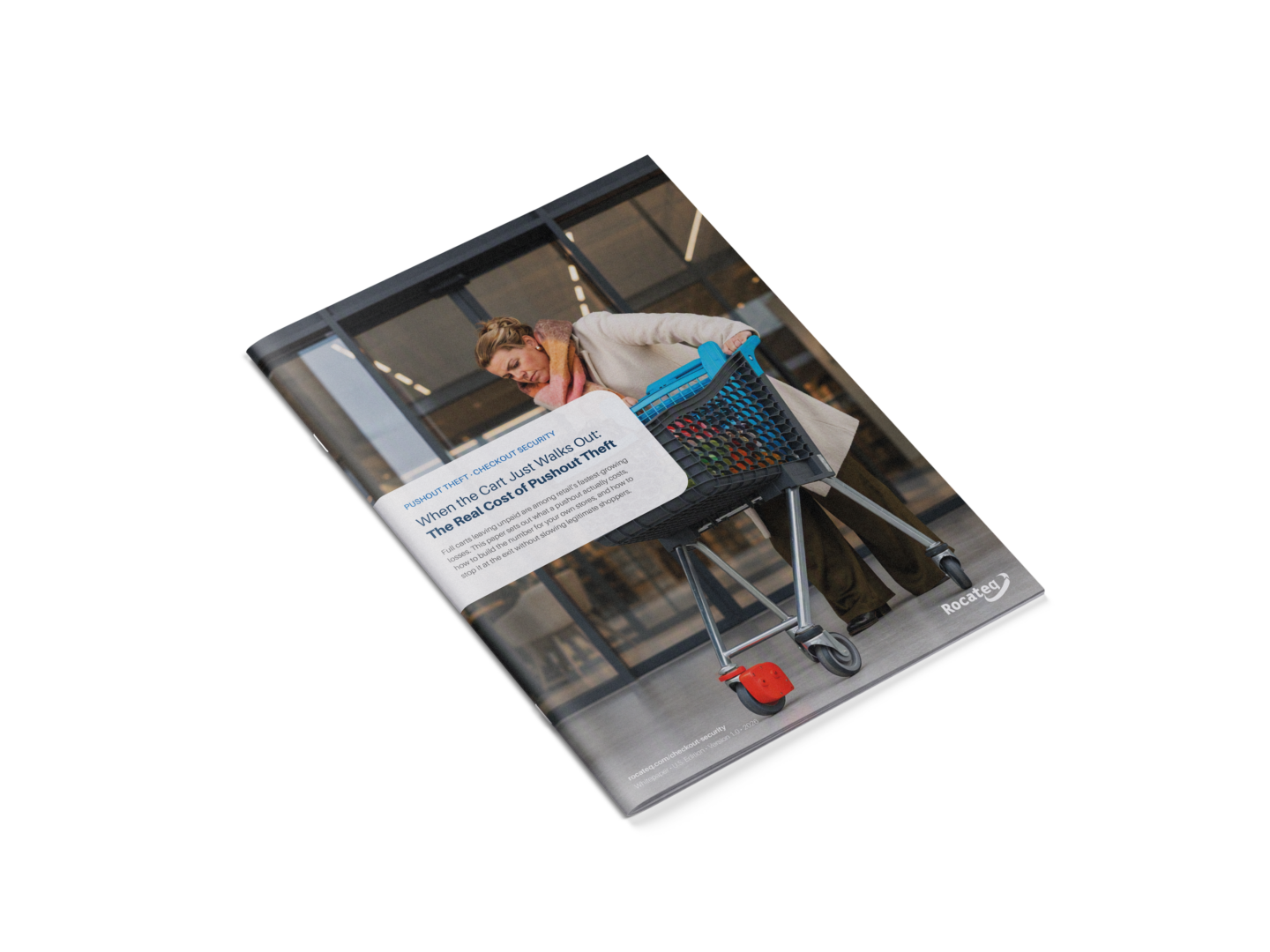
Most stores already have several layers of protection. Cameras, EAS gates, alarms, staff awareness and sometimes security guards all play a role. But each of these measures has limitations.
Cameras can record what happened, but they do not physically stop a cart from leaving. They are useful for investigation, but less effective as a direct barrier in the moment of theft.
Electronic article surveillance gates can detect protected items, but they are not designed to stop a full cart of unpaid goods if those items are not individually tagged or if the theft method bypasses that type of detection.
Staff awareness helps teams recognize suspicious behavior, but employees cannot watch every cart, every exit and every self-checkout transaction at the same time. And even when they do notice something, a no-intervention policy still limits what they can do in the moment. Awareness may help identify the risk, but it does not physically prevent a cart from leaving the store.
Security guards can help, but they are costly, not always available and may not be present at every entrance or exit. Many stores cannot rely on permanent door security, especially across multiple locations or during all opening hours.
The prevention of a cart full of unpaid merchandize is often a blind spot for store operations. The store has people who can see the issue. It has cameras that can record it. It may have policies that define what employees should or should not do. But there is often nothing that acts on the cart itself. And in push-out theft, the cart is the vehicle that makes the incident possible.
For head office, the challenge is even bigger. A single store may be able to describe what happened. But across a retail network, the same type of incident can be recorded differently, reported inconsistently and managed according to local practices. That makes it difficult to compare locations, identify recurring patterns or understand where the greatest exposure exists.
The gap is therefore not only at the exit. It is also between what happens in the store and what the wider organization can see, measure and act on.
For store teams, the ideal solution is not one that asks them to take more risks. It is one that removes the need for confrontation in the first place. What would help is something automatic. Something that does not rely on an employee making a split-second judgment at the exit. Something that does not require staff to decide whether a person is suspicious, whether a receipt is valid, or whether it is safe to intervene.
In practice, the store needs a simple question to be answered at the exit: Has this cart been through a valid checkout process, yes or no?
If the answer is yes, the customer should continue without friction. Honest shoppers should not notice anything unusual and the normal shopping experience should remain smooth.
If the answer is no, the store needs a way to respond without putting employees directly in the path of the person pushing the cart.
That is the real value of stopping shoplifting without confrontation. It protects the store’s profit margins while also protecting the employees. It would also help if evidence was captured automatically. Instead of asking managers to spend hours reviewing footage after the fact, relevant event data should be available in a clear and structured way. That makes it easier to understand patterns, support internal reporting and separate suspected incidents from confirmed events.
Store employees are often the first to notice push-out theft. They see the behavior, recognize the patterns and understand how it affects daily store operations. But they cannot solve the issue by themselves and they should not be expected to.
A no-intervention policy is the right choice when employee safety is at stake. But if retailers stop there, they leave the exit unprotected. The result is a gap between what the team can see and what the store can actually prevent.
The next question is not whether store employees are paying attention. The real question is: what is push-out theft costing your organization when nobody, and nothing, is able to stop the cart?
The Rocateq business case turns your inputs into an ROI and payback figure specific to your stores, using your loss rates, your product mix and your margins.
We are happy to review the business case with you in a no-obligation meeting, using your store data to identify where the greatest financial and operational gains can be achieved.
Schedule your store review